
Katong +65 9780 7274
Embrace Physiotherapy · Katong

Six weeks post-birth, or six years? It is not too late to recover properly.

Postnatal physiotherapy in Katong for abdominal separation, core strength, scar recovery and the pelvic floor. Bring the baby.

Nothing proceeds without your consent. You can ask us anything first on WhatsApp.

Katong

How we assess it

Four things that have to work together.

A postnatal check is not a quick look at a gap. Tap each one to see what we mean.

An assessment covers all four in one appointment, and you are welcome to bring your baby.

Book a postnatal assessment
A dedicated women's clinic5 women's health physiotherapists
Singapore registeredAllied Health Professions Council
Baby and kid friendlya change table and toys onsite
Katong650m walk from Marine Parade MRT

Sound familiar?

Common is not the same as normal.

The gap that has not closed. The cough that catches you out. The core that will not switch on. The scar you have been avoiding touching.

Up to 60% of women still have abdominal separation at 6 to 8 weeks after birth, so you are in very ordinary company. But common is not the same as normal, and nothing here needs to be waited out.

01

A gap or doming down the middle of your abdomen

02

A core that feels absent, or a back that has started to complain

03

Leaking, heaviness or urgency since the birth

04

A caesarean or perineal scar that is tight, numb or tender

05

No idea whether you are cleared to run, lift or go back to class

Our approach

The six week check is a starting line, not a finish line.

A postnatal assessment is not a quick look at a gap. We assess the deep core system, the pelvic floor, your breathing and how you manage pressure, because those four things work together or not at all. And postnatal has no expiry date. Whether you gave birth eight weeks ago or eight years ago, the assessment is the same and so is the opportunity.

  • Assessment of abdominal separation, deep core function and pelvic floor recovery together
  • Scar work for a caesarean or perineal scar, including tears and episiotomy
  • An assessment that may involve an internal examination or real-time ultrasound, only with your consent
  • A clear answer on returning to running, lifting and class, rather than a guess
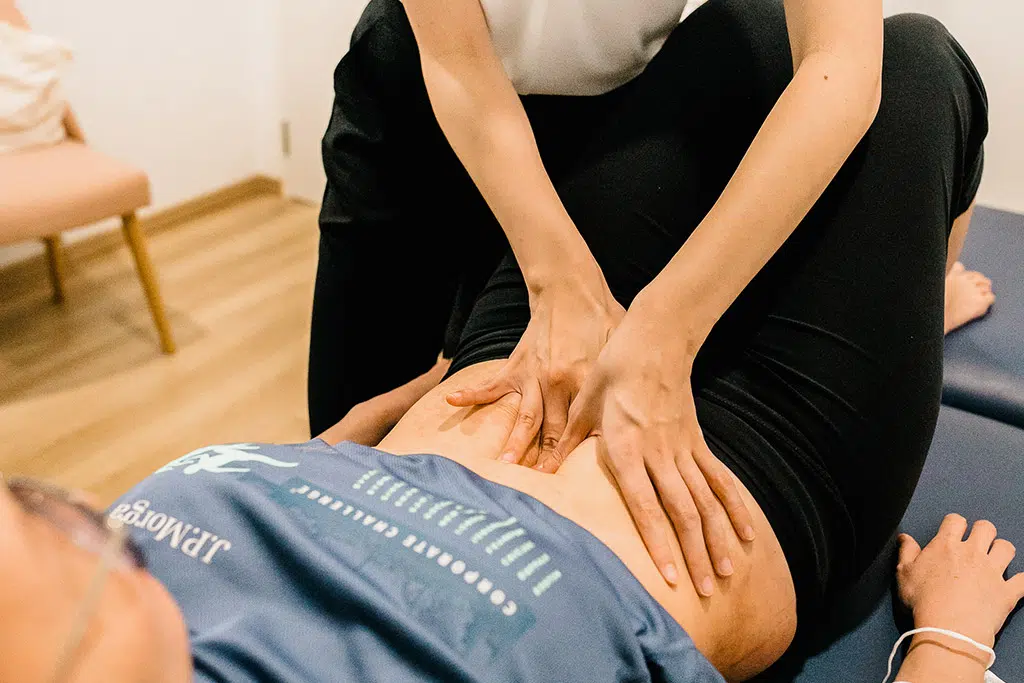
A physiotherapist giving hands on treatment to a client lying on a treatment bed
Babies are welcome

We are a baby and kid-friendly clinic, with a change table and toys onsite.

What we treat

Six things new mothers are told to live with.

01 Abdominal separation

Diastasis recti is not about closing the gap

Abdominal muscle separation is common during pregnancy and afterwards, and the sooner it is assessed the sooner you can rebuild. Even without pain, separation is linked to a loss of abdominal strength and to how women feel about their bodies, which matters just as much.

  • We measure and assess the separation properly rather than eyeballing it
  • You learn to engage the deep core system and set a foundation for recovery
  • Exercise is graded to what your abdominal wall can actually manage right now

Book for abdominal separation
02 Your six week check

The postnatal assessment nobody books

The six week appointment with your doctor clears you medically. It does not tell you whether your pelvic floor is working, whether your abdominal wall has recovered, or whether your body is ready for the thing you actually want to do next.

  • A pregnancy and birth history taken properly, including how the birth went
  • Pelvic floor function assessed safely and expertly, with your consent
  • A plan for the next few months rather than a single verdict
Book for your six week check
03 Pelvic floor after birth

Leaking, heaviness or urgency since the birth

Leaking on a cough or a run, a sudden urge you cannot put off, or a feeling of heaviness that is worse by the end of the day. These are common after birth and they respond well to treatment. They are not the price of having a baby.

  • Assessment of strength, coordination and whether the muscles time their contraction
  • Training that goes beyond squeezes: breathing, pressure management and how you lift
  • Heaviness assessed properly, because a tight pelvic floor can feel much like a prolapse
Book for pelvic floor after birth
04 Scar recovery

Caesarean and perineal scar recovery

A caesarean scar that is tight, numb or tender. A perineal tear or episiotomy that still makes you wary. Scar tissue responds to hands-on work, and so does the confidence that goes with it.

  • Caesarean scar tissue healing alongside pelvic floor muscle recovery
  • Perineal scar work after tears, episiotomy, or third and fourth degree tears
  • Gentle, unhurried, and it stops the moment you want it to
Book for scar recovery
05 Aches and pains

The back, neck and wrists nobody warned you about

Feeding posture, carrying, lifting a car seat and broken sleep add up. Lower back, neck, wrist and hip pain are all common after birth and all treatable, and they are not something to simply endure until the baby is older.

  • Hands-on treatment for lower back, neck, wrist, hip and coccyx pain
  • Practical changes to feeding, carrying and lifting that actually fit your day
  • Strength work that rebuilds capacity rather than just relieving the symptom
Book for aches and pains
06 Getting back to exercise

Running, lifting and class again

The question we are asked most often. The honest answer depends on what your pelvic floor and abdominal wall can do under load, which is something we can test rather than guess. Then we build the bridge from here to there.

  • Return to exercise with one to one clinical exercise and Pilates
  • Graded loading, so the first run back is not also the last one
  • Small group classes of one to four, after a pre-exercise class assessment
Book for getting back to exercise

None of them are on that list here. Each one is assessed the same careful way.

Also at the clinic

The rest of what we do.

Recovery rarely stays in one lane, so the rest of the clinic is here when you need it.

A mother on an exercise mat with her baby beside her
01

Pre and postnatal physiotherapy

Feel capable throughout your pregnancy and beyond, with a whole-person approach.

02

Women's health physiotherapy

From first period, to first baby, to first flush. We support you through every stage.

03

Lactation physiotherapy

Effective treatment provides relief so you can focus on feeding with comfort.

04

Clinical Pilates and exercise

Rebuild strength and control with targeted movement in one to one or one to two sessions.

How it goes

Your recovery, in six stages.

Explore

We start by understanding you. Your concerns, your symptoms, how the birth went, and what has been changing. Your pelvic floor is assessed safely and expertly, and we look at how the deep core system is working.

Educate

We set goals together and create a tailored treatment plan, with clear guidance on next steps and what to expect. You leave understanding your body better than when you arrived.

Equip

Hands-on care in the clinic and exercises tailored to your goals, your environment and your schedule. At-home care becomes increasingly important, so we make it something you can actually do.

Engage

We move from hands-on care toward movement-based strategies for resilience, including small group classes of one to four, and gradually return to the activities you have been avoiding.

Establish

We refine movement quality and solidify good habits, adding complexity and challenge to your movement patterns as your confidence and strength build.

Embrace

You stay in tune with your body and address early signs of discomfort. We stay available for check-ins, so if something shifts later you are never starting from scratch.

A mother sitting outdoors with her baby

Who you will see

Physiotherapy for women, by women.

Every physiotherapist at the clinic is a woman, and all of them work in women's health. You will be assessed and treated by the same person throughout, not passed around.

Brenda Lee, Senior Musculoskeletal and Women's Health Physiotherapist

Brenda Lee

Senior Musculoskeletal and Women's Health Physiotherapist

Elizabeth Boey, Senior Women's Health and Musculoskeletal Physiotherapist

Elizabeth Boey

Senior Women's Health and Musculoskeletal Physiotherapist

Genevieve Chan, Senior Musculoskeletal and Women's Health Physiotherapist

Genevieve Chan

Senior Musculoskeletal and Women's Health Physiotherapist

Chia Ling Mah, Senior Musculoskeletal and Women's Health Physiotherapist

Chia Ling Mah

Senior Musculoskeletal and Women's Health Physiotherapist

Preet Singh, Director and Women's Health Physiotherapist

Preet Singh

Director and Women's Health Physiotherapist

Founded the clinic and leads its women's health care.

Meet the whole team

Visit us

Find us in Katong.

Katong

410 & 410A Joo Chiat Road, Singapore 427636

Mon & Thurs 8am to 8pm

Tue & Wed 8am to 6pm

Fri 8am to 4pm

Sat 8am to 4pm

Sun & Public Holidays closed

Get directions Book at Katong

Getting started

Your first appointment

Sixty minutes, one physiotherapist, and no rush. We take your history, assess what is going on, explain it in plain language, and start treatment. You go home with something to do and a clear idea of what comes next. Bring the baby. There is a change table and toys onsite.

Before you book

The questions we hear most.

When is the right time to start postnatal physiotherapy?

There is no window you can miss, and no date you have to wait for. If something feels off in the early weeks, or you simply want a head start, come in sooner. Many women come at around six weeks for their postnatal assessment, and plenty come months or years later, which is just as worthwhile. The assessment meets you wherever you are.

What actually happens at a postnatal assessment?

We take a full history including how the birth went, your bladder and bowel habits, and what has been changing. Your pelvic floor is assessed safely and expertly, and in some cases we may recommend an internal vaginal examination or use real-time ultrasound. Nothing proceeds without your consent.

Can I bring my baby?

Yes. We are a baby and kid-friendly clinic, and there is a change table and toys onsite to make the appointment as easy as possible.

Do I need a doctor's referral?

No. You can book straight into the diary. If you do have a referral letter or any investigations, please bring them along, or send them ahead by email or WhatsApp.

How much does it cost?

Every appointment type carries its fee in the booking diary on this page, which is where we keep pricing current.

Can I claim this on insurance?

If your insurance policy includes physiotherapy coverage, your sessions may be claimable. Check with your provider first to confirm coverage and whether you need a doctor's referral, and tell us at payment if you need a diagnosis on your receipt, a hard copy or an insurance memo.

Can I join a class instead?

Classes are physiotherapist led and run in small groups, and you need a pre-exercise class assessment before your first one. That assessment doubles as a proper look at where your recovery is up to.

Where are you and how do I get there?

We are at 410 and 410A Joo Chiat Road in Katong, a 650m walk from Marine Parade MRT. If you are coming via Dakota MRT, bus 16 gets you close. Street parking is available, with paid options at Katong Point Shopping Centre and Joo Chiat Road Car Park.

Book online

Book a postnatal assessment in Katong

The diary below is our own Cliniko booking screen, so what you see is genuinely available. Every appointment type shows its fee before you confirm.

Would rather ask a question first? Call us on +65 9780 7274. Or message us on WhatsApp.

Ready when you are

Put yourself first for one hour.

Postnatal physiotherapy is a chance to do that at a time when self-care can take a back seat. Message us on WhatsApp, or book straight into the diary below.

Embrace Physiotherapy · Katong

WhatsApp Book Call+65 9780 7274